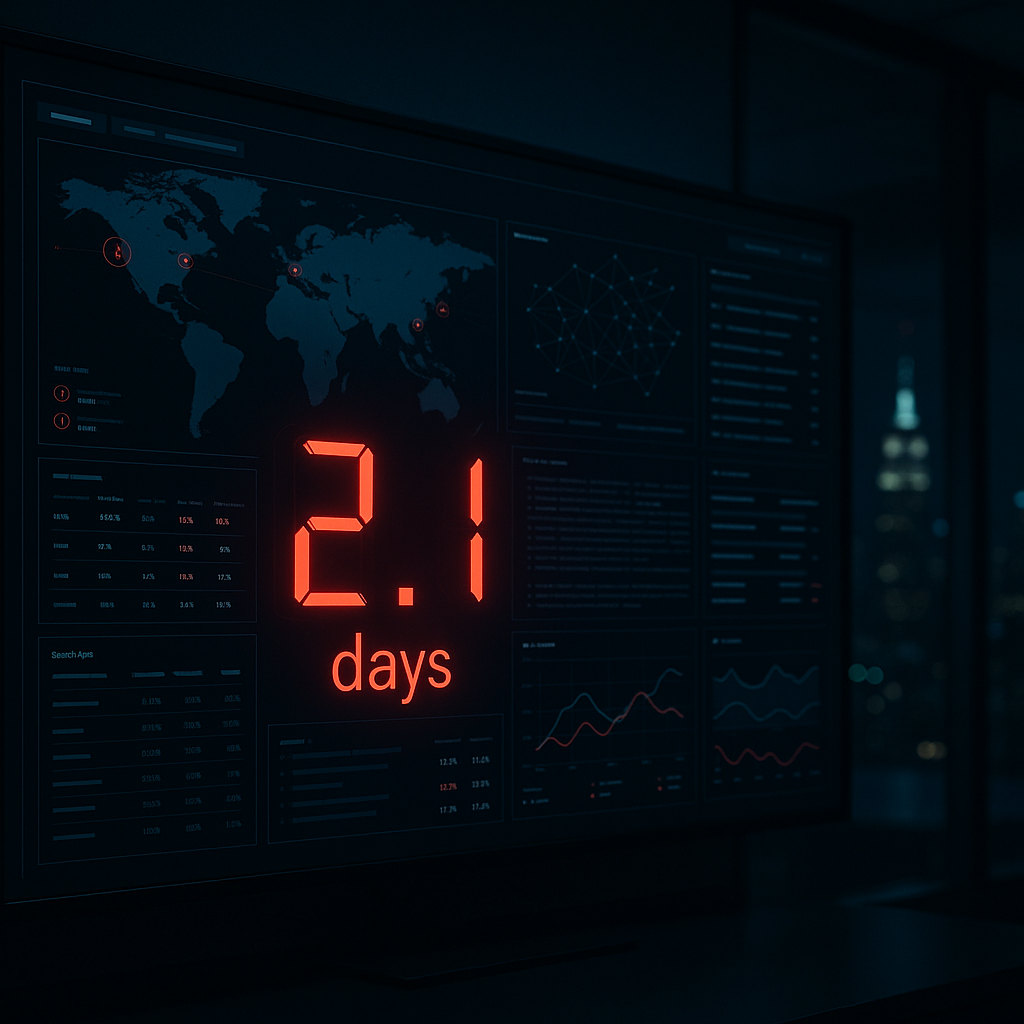
Zero-Day Vulnerabilities Are Now Exploited in Under 3 Days: What NYC Businesses Must Do Now
A true zero-day is a flaw attackers use before the vendor and the public have a patch. A lot of what businesses feel in 2026 is the other clock: N-day, or post-disclosure velocity — how fast a published CVE or public proof-of-concept gets exploited. CrowdStrike’s 2026 Threat Hunting Report (H1 2026) found that 88 percent of the PoC-backed exploitation it observed landed within 48 hours of the PoC’s release. That is days, not months, and it is what turns a Patch Tuesday note into a New York City business problem in the same work week.
For NYC small businesses, this timeline is not an abstract threat model. It is the current reality of cybersecurity in 2026. Microsoft alone patched on the order of 421 vulnerabilities in August 2026, including one confirmed in-the-wild zero-day (CVE-2026-68820, WinSock use-after-free LPE). Attackers did not need months to exploit them. They moved in days, sometimes hours.
What Is a Zero-Day Vulnerability?
A zero-day vulnerability is a software flaw that the vendor and the public are unaware of. Attackers discover it first, exploit it, and by the time the vendor releases a patch, the vulnerability already has a zero. That means zero days of defense for the people who need protection the most. Zero-day vulnerabilities are the most feared threat in cybersecurity because they bypass every conventional defense.
In 2026, the zero-day threat landscape has intensified dramatically. The “71 percent same-day” figure does not hold up. What Rapid7’s 2026 Global Threat Landscape Report actually measured is the count of exploited high- and critical-severity vulnerabilities (CVSS 7–10) rising from 71 in 2024 to 146 in 2025. CrowdStrike, looking at H1 2026, said 88 percent of observed exploitation of vulnerabilities that already had a public PoC happened within 48 hours of that PoC. The days of having weeks or months to patch the ones attackers actually weaponize are over.
Why Zero-Day Exploitation Has Accelerated So Dramatically
Several converging factors have turned the zero-day clock into a stopwatch:
- Automated vulnerability scanning: Attackers use AI-powered tools to continuously scan for newly disclosed vulnerabilities across thousands of software products. When Microsoft, Cisco, or Adobe releases a patch, threat actors automate the analysis of the patch itself to identify the vulnerability instantly.
- Exploit-as-a-Service: Cybercrime organizations now sell pre-packaged zero-day exploits on underground markets, allowing attackers with minimal technical skill to deploy sophisticated attacks. The barrier to entry has collapsed.
- AI-assisted reverse engineering: AI tools can analyze patched code and reverse-engineer the underlying vulnerability in minutes, generating functional exploit code faster than human analysts can assess the threat.
- Supply chain amplification: Vulnerabilities in widely-used infrastructure, such as network security appliances, cloud platforms, and development tools, mean that exploiting a single zero-day can compromise thousands of businesses simultaneously.
The August 2026 Patch Tuesday: A Case Study
August 2026 was a cautionary tale for every business using Microsoft products. The monthly patch cycle included about 421 CVEs (counts vary by how outlets tally the release). Microsoft confirmed one in-the-wild zero-day in that cycle — not four, and not three RCEs:
- CVE-2026-68820: August 2026 in-the-wild item. Use-after-free in the Windows Ancillary Function Driver for WinSock (afd.sys). Local elevation of privilege to SYSTEM, not remote code execution. Microsoft patched it August 11, 2026.
CVE-2026-33825 (BlueHammer) is an April 2026 Microsoft Defender local privilege escalation, not an August RCE. Do not treat the April–May Defender nicknames RedSun or UnDefend as August Patch Tuesday remote exploits.
These were not obscure flaws found in enterprise software used by 500 companies. They were vulnerabilities in core Windows components used by every small business in Staten Island, Manhattan, Brooklyn, and New Jersey that runs a PC or laptop.
Why Small Businesses Are Especially at Risk
Zero-day attacks do not discriminate, but small businesses pay a disproportionate price. Here is why:
- No dedicated patch management: Many NYC SMBs do not have automated patch management. A small IT team or an owner manually updating computers simply cannot keep pace with the velocity of vulnerabilities that now arrive weekly.
- Legacy systems and unsupported software: Small businesses often run older software that no longer receives security updates, leaving them exposed to exploits that newer, patched systems would resist.
- Limited visibility: Without continuous monitoring, a small business often will not know they have been targeted until data is stolen, systems are encrypted, or the ransom note appears.
- Insurance gap: Small businesses often underestimate the financial impact of a zero-day breach. The ransom note is only part of the bill. Downtime, restoration, legal work, and reputational damage usually dwarf whatever is demanded, and many small businesses underestimate that total cost until they are in it.
The Defense Strategy: What NYC Businesses Can Do Right Now
You cannot patch a vulnerability that has not been disclosed. You cannot prevent an attack that bypasses traditional defenses. But you can significantly reduce your exposure and limit the blast radius if a zero-day exploit reaches your network.
1. Automate Patch Management
The single most effective defense against zero-day exploits is rapid patching. Microsoft Endpoint Manager, Intune, or your managed IT providers automated patch management solution should be configured to deploy security updates within 48 hours of release. Manual patching is no longer viable in a zero-day world.
2. Deploy EDR and Managed Detection
Endpoint Detection and Response (EDR) solutions like Huntress, SentinelOne, and CrowdStrike provide continuous monitoring that detects exploit attempts in real time, even before a patch exists. EDR tools use behavioral analysis, not just signature matching, to identify and block zero-day exploits as they are deployed.
3. Implement Network Segmentation
If an attacker exploits a zero-day on one machine, network segmentation prevents lateral movement. Keep guest Wi-Fi separate from business networks. Isolate sensitive file servers. Restrict admin access. Each segmented zone is a boundary that the exploit must break through to cause damage.
4. Practice Incident Response
Assume a zero-day exploit will reach your network. Do not hope it will not. Have a documented incident response plan that includes: who to call, how to isolate affected systems, how to restore from backups, and how to communicate with clients and employees if data is compromised.
5. Maintain Offline Backups
The final defense against zero-day exploits that turn into ransomware is having backups that are completely offline and immutable. If your files are encrypted by a zero-day exploit, offline backups are your only way to restore without paying a ransom. The 3-2-1 backup rule applies: 3 copies, 2 different media types, 1 offsite.
Why Managed IT Is Not Optional in the Zero-Day Era
The zero-day threat landscape has fundamentally changed the value proposition of managed IT services. This is no longer about IT as a cost center, it is about IT as your primary cybersecurity defense layer.
At MicroSky, our managed IT services include:
- Automated patch management across all endpoints: We ensure your systems are patched within hours of critical updates, not weeks or months.
- EDR deployment and monitoring: We deploy and actively monitor EDR solutions that detect zero-day exploits at the behavioral level, blocking them before they execute.
- Network segmentation design: We architect your network to contain threats and prevent lateral movement, even if an exploit bypasses your perimeter defense.
- 24/7 SOC monitoring: Our security operations center monitors for threat intelligence updates, zero-day alerts, and anomalous activity around the clock.
- Disaster recovery planning: We design and test backup and recovery procedures that keep your business operational even if a zero-day exploit strikes.
The Clock Is Ticking
Forty-eight hours is the window CrowdStrike reported for most of the public-PoC exploitation it saw in the first half of 2026. That is the window between a working exploit becoming public and it showing up against businesses like yours. With 421 vulnerabilities patched in a single Microsoft update cycle and attackers moving faster every month, the window will only shrink.
Small businesses in NYC that rely on manual IT processes and hope for the best are leaving the door wide open. The attackers have automated tools. They have AI-powered scanning. They have public PoCs and N-day exploits that get used inside a couple of days.
Your defense needs to be automated too.
Is your NYC business protected against zero-day exploits? Call MicroSky at (718) 672-2177 or visit microskyms.com to schedule a cybersecurity assessment. Serving businesses across New York City, Staten Island, New Jersey, and the tri-state area.